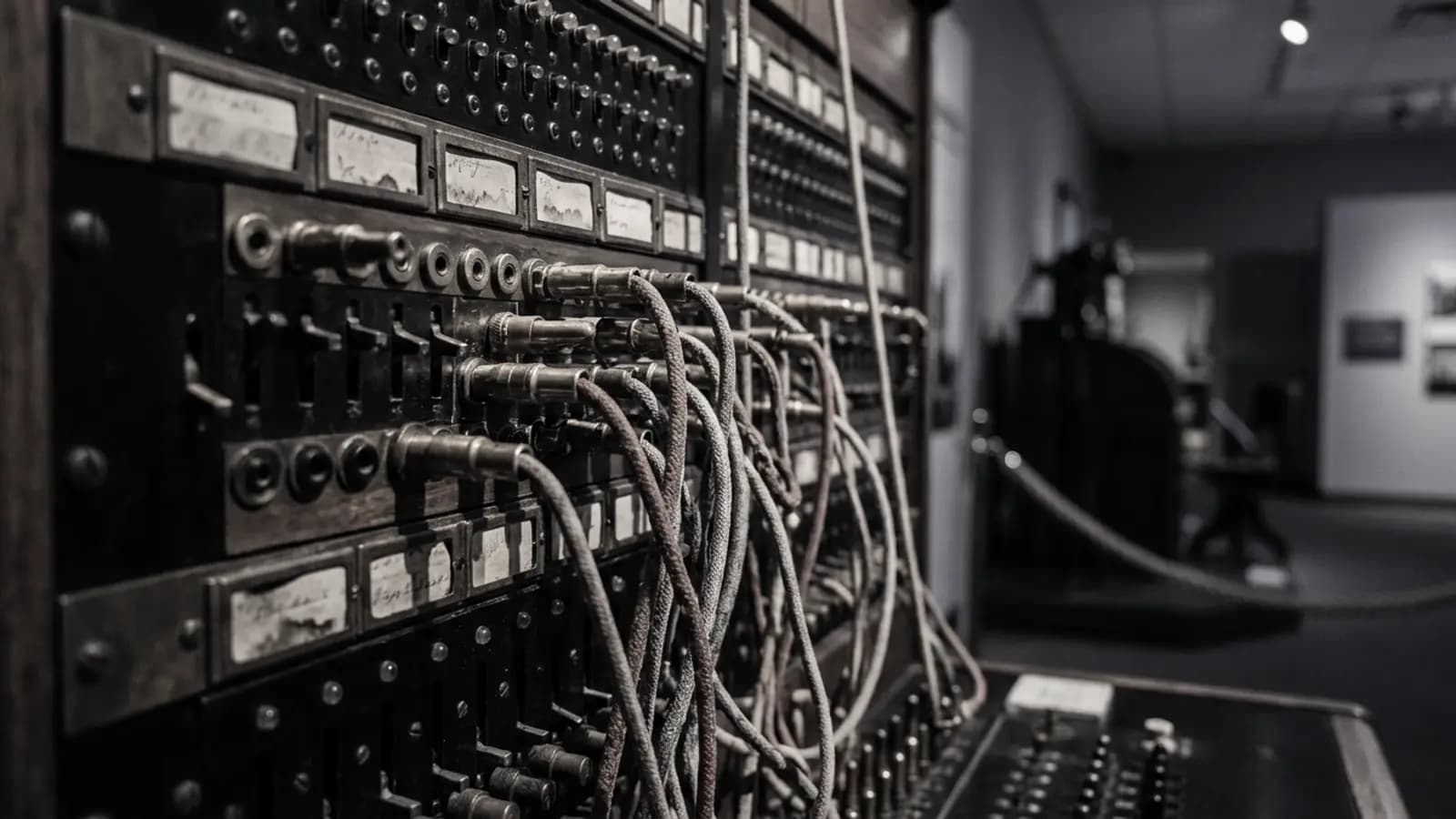
Fax timeline
One hundred and eighty years of sending pictures at a distance, in twelve milestones.
Fax predates the telephone. In 1843, Scottish clockmaker Alexander Bain patented a device that could reproduce a pattern at a distance, scanning a surface line by line with two synchronised pendulums. Every machine since has borrowed that idea; only the channel has changed, from telegraph wire to telephone line and then to IP networks. The decisive turning point came in 1980, when the CCITT published the Group 3 standards (T.4 and T.30): a page now took under a minute, and that shared language is still the one today's faxes use.
Key milestones
1843
Two pendulums and a patent
Alexander Bain is granted a British patent for an electric clockwork mechanism able to copy raised type at a distance. One stylus sweeps the original, another reproduces the pattern on chemically treated paper at the other end: line-by-line scanning is born.
1848
The rotating cylinder
English physicist Frederick Bakewell patents an "image telegraph" that wraps the document around a spinning cylinder traced by a metal point. Shown at the Great Exhibition in London in 1851, this rotating-drum principle would equip generations of machines.
1865
Paris to Lyon by pantelegraph
Italian priest Giovanni Caselli sees his pantelegraph taken up by the French telegraph administration. The Paris–Lyon line opens to the public, and bankers and merchants use it to send handwriting and signatures. The service never pays its way and fades out around 1870.
1913
The portable Belinograph
Frenchman Édouard Belin unveils a transportable version of his Belinograph that works over a telephone line. Newspapers seize on it to send news photos; in France, a "bélino" long meant a picture received by wire.
1924
Press photos take to the line
AT&T sends pictures of the Republican convention in Cleveland to New York over telephone lines. Late that year, RCA transmits a photograph from London to New York by radio. Picture transmission becomes a routine service for newsrooms.
1948
Fax moves into client offices
Western Union launches Desk-Fax, a small unit installed at business customers' premises to exchange telegrams as images with the telegraph office. Fax becomes an everyday working tool rather than equipment reserved for the press.
1964
Long-distance xerography
Xerox unveils LDX (Long Distance Xerography), which pairs scanning with xerographic printing to send documents between a company's sites over dedicated high-capacity links. Still expensive, it foreshadows the office fax.
1966
The Telecopier on an ordinary line
Together with Magnavox, Xerox brings out the Magnafax Telecopier: around 20 kilograms, a telephone handset resting in an acoustic coupler, six minutes per page. For the first time, an office worker can fax from any telephone extension.
1968
A first shared language
The CCITT, forerunner of the ITU-T, adopts the Group 1 standard (T.2): still six minutes a page, but machines from different makers can finally talk to each other. That same year, the Carterfone decision opens the US network to third-party equipment. In 1976, Group 2 (T.3) would cut the page to three minutes.
1980
Group 3: a page in under a minute
Two texts, T.4 to digitise pages and T.30 to steer the call, take fax digital: white areas compressed, speed negotiated automatically, each page confirmed. Japan, whose script was ill-suited to telex, quickly makes it standard office kit.
1998
Fax learns IP
T.38 receives ITU-T approval. Gateways can now convert a fax machine's signal into data packets and rebuild it at the destination, so fax travels over voice-over-IP networks without the devices themselves having to change.
2020s
The end of copper
European operators are shutting down the switched telephone network, area by area. Fax machines move behind routers or adapters, while sending from a browser, with no device and no subscription, becomes the most direct way to dispatch the occasional fax.
1980: a standard built to last
Group 3 succeeded where others failed for a simple reason: it ran on the phone line every office already had. Group 4, standardised in 1984 (T.6), was faster and sharper, but required an end-to-end ISDN line. Businesses chose what worked with their correspondents, not what was technically superior.
Each G3 machine sold made owning one more worthwhile; by the 1990s, the installed base ran to tens of millions worldwide. Instead of replacing it, standards bodies kept extending it: ECM, MMR compression, V.34 modulation, and then T.38 to carry it over IP without touching the original dialogue.
That is why a fax machine from the 1980s can still receive a page sent from a smartphone today: both ends follow the same T.30 procedure, and only the path between them has changed.
Where faxing stands today
The machine in the corner of the office is living out its final years: it relies on an analogue socket that fibre is replacing. The service itself has broken free of the hardware. All it takes is a destination number, a file and a delivery confirmation, and all of that can be sent from a browser.
That confirmation is still what keeps fax in hospitals, law firms and many public services. The tool has changed shape with every generation; the need to know that a document has really arrived has never gone away.
Fax history: your questions answered
- Who actually invented fax?
- The principle goes back to Scotsman Alexander Bain, who patented it in 1843. Frederick Bakewell refined it, and Giovanni Caselli ran it commercially from 1865. The office fax as we know it, though, is the result of collective standardisation work within the CCITT, crowned by Group 3 in 1980.
- Did fax truly come before the telephone?
- Yes. Bain filed his patent in 1843, Alexander Graham Bell his in 1876. It would take until the 1920s for the telephone line to become the usual medium for sending pictures.
- Which standards does a fax use in 2026?
- Still the Group 3 set: T.4 to code the image and T.30 to run the call, often supplemented by ECM and T.6 MMR compression. When part of the route crosses an IP network, T.38 wraps that dialogue in packets.
- Does faxing have a future?
- The physical machine is in retreat as the copper network shuts down. Fax as a way of transmitting documents remains in demand wherever an organisation insists on proof of delivery, and these days it runs perfectly well without a machine. The medium changes; the use endures.
Telephone network
In this section
Where to go next
Hand-picked pages to help you prepare, send or prove your fax.
- What happens, second by second, while a page travels from one fax machine to another.
- Proof, speed, price: what each one brings, with figures.
- Fourteen technical words, from the calling tone to the transmission report.
On the same topic
Recent guides
Blog articles on the same subject.